Arm The Dolls! ... But what does it all mean?
A look at practicable community steps towards keeping trans women safe
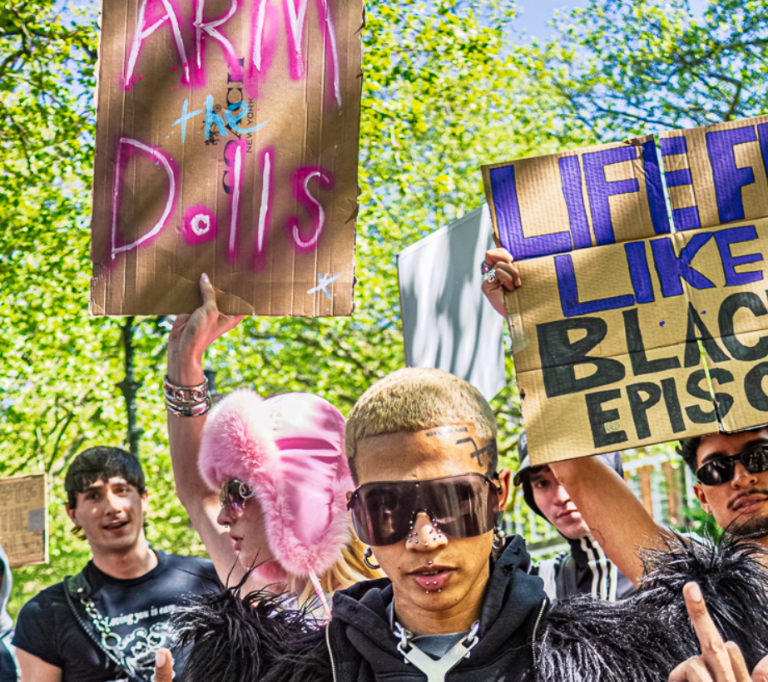
I saw a sign on Instagram that said “Arm the dolls”. On the morning of the big trans protest, I went to a banner making with my girlfriend, who made a sign that similarly said “Arm trans women”. Across the table from us, a friend wondered out loud how to summarise the feelings of this current moment in a few words on a sign. I handed her my phone to show her an essay a friend had sent me, Arm the Dolls by Sarah Harpy.
It’s a provocative essay. One paragraph says of white American trans women who have started arming themselves recently “See plenty of settler trans women are already armed. It’s popular and cute in our subcultures for white trans women to take thirst traps with their guns. This means almost nothing. Isolated gun fetishists will mean nothing when it comes to actually fighting a war against the state. A sister of mine compared them to those white settler rhodesian women who armed themselves against Zimbabwean revolutionaries. Without a revolutionary political-military theory and practice that sets us against the imperialist state and all of patriarchal civilization we, as settler trans women, are just as likely to die for white supremacy as we are to fight against it.”
The essay also contains sentences like this that have stuck with me non-stop since first reading: “We don’t need instagram videos, we don’t need t-shirts, we need patriarchal civilization to be weakened by war on many fronts.”
A lot of Sarah Harpy’s writing focuses on separatism, on what Margaret Killjoy recently called The Demiground, what I would call “the disappearing act”, as a revolutionary necessity. This concerns the capacity that revolutionary movements have to be invisible to the state and to broader society generally. As dual power is built the discursive spaces and communities of the revolution supersede the mainstream and absorb its useful parts. This is an element of revolution that people need to understand for its many complicated manifestations and facets: Russian revolutionaries in 1917 had safehouses, trade union and then soviet organised meeting spaces and communication channels; people’s militias in Myanmar have physical places, bases, communication networks that the Junta cannot see; activist occupations and squats use signal chats. At the same time but completely different due to an utterly different context, the American fascist movement of the 2010s and 2020s have a huge network of telegram channels as well as alternative far-right social media platforms that they were using for years before Musk’s ideological realignment of Twitter. Revolutions must pull off the disappearing act to be viable, because this is where the movement gains consciousness as a distinct social organism from the mainstream, and because these unseen spaces are consequently where a lot of the most radical planning is done.
Spaces into which trans women, especially trans women of colour can disappear become more vital as the patriarchy makes it more clear and more public its wish to completely exterminate us, but they are only one part of a struggle. To arm someone means to give them agency, and the nature of agency means that whether it is used to defend, to attack, to disappear, is not the place of the party granting it to say.
Just before the first paragraph I quoted from her essay, Harpy writes: “A real life example of what i mean. In Harlem recently a young trans woman of color, Jaia Cruz, was attacked by a man in a deli. The man struck Jaia repeatedly, calling her a faggot and a tranny. Jaia stabbed him in self defense and her attacker died. She was sent to Rikers island without bail and, after accepting a plea deal, got 15 years in prison. Her official sentencing is at the end of May and while there is a small movement to free her, very few of us trans women want to understand what Jaia Cruz’s case means for us. As with CeCe McDonald back in 2011, Jaia Cruz’s sentence proves that there is no legal way to defend yourself as a trans woman of color. White sisters haven’t picked this up yet.”
In the political context of the UK, gun ownership is illegal and practically nonexistent, the concept of an armed revolutionary war against the state is lightyears outside of the public consciousness, and so arming the dolls has to mean different things in order to be more pragmatic than the popular but vague slogan “protect the dolls” which Harpy mocks in her essay.
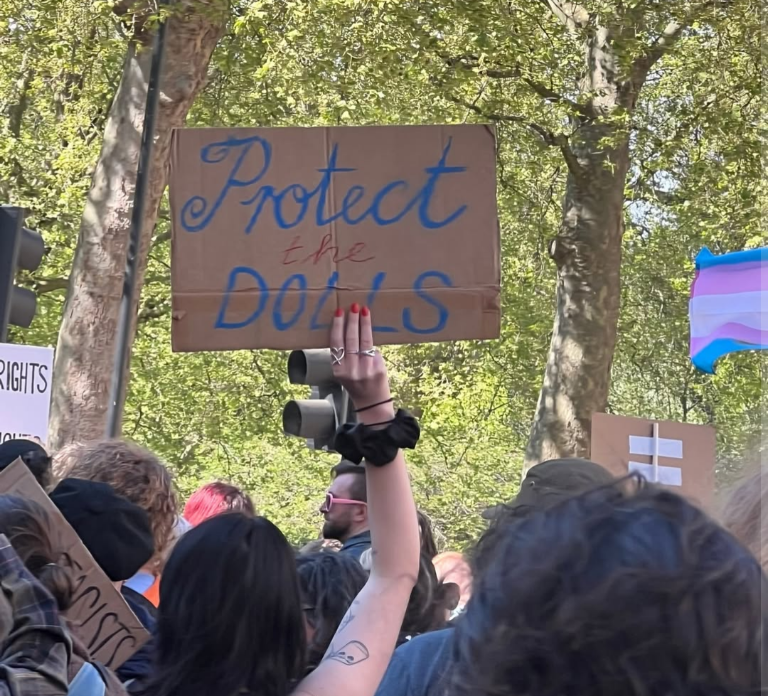
So if we imagine a trans community assembly convening to talk about our issues, and we wanted to bring an “arm the dolls” agenda to the floor, what practical steps are we telling everyone to take?
We need to talk about threat modelling. We have to understand not only what threats there are but who is under threat in order to protect them. The biggest immediate threats of physical danger to trans women are from bigoted violence and arrest.
Bigoted violence can be further broken down into the kind of street attacks that Cruz and McDonald were defending themselves against and the cases of domestic violence and violence against sex workers by clients who view them as a type of person it is acceptable to abuse. This means that trans women of colour, trans women who are financially dependent on their partners and survival sex workers are the most at risk members of our community, and not just protecting but also enabling them to protect themselves includes preventing them from being imprisoned.
Prison is grim for everyone by design. For the credibility of punishment-as-justice to be viable, prisons must be places that people suffer by definition. However, for there to be a political movement that fights for our liberation, in a context where prison for trans women means a cage where we are abandoned to be raped until we die, we need to make de-arrest training a fundamental in queer spaces. We also need to engage in intensive prison support for any trans woman who is incarcerated. Here if “protecting the dolls” means keeping trans women off the front lines of direct action to prevent arrest, arming the dolls means in the worst case helping every trans woman survive incarceration and in the best case never letting the cops take a single doll.
I am a white trans woman, and so while I will continue to be critical of separatism in this article I want to be clear that I am making those criticisms deliberately from a place of privilege. When I talk about things that can be done to involve and rely on the support of cis people, that is because I know it will be harder for trans women of colour to get white cis people’s support and so I am urging other white trans women to recognise our relative privilege and act on it in a way that will not only protect us but will protect our more vulnerable sisters too.
I’m going to trot out the survivability onion, and hopefully my metaphor will only add flavour as it is dissected. This onion was originally used in military theory for protecting a vehicle from attack (hence the tank in the picture) but has been used as an aid to threat modelling for active shooter situations and for teaching basic concepts of threat modelling.
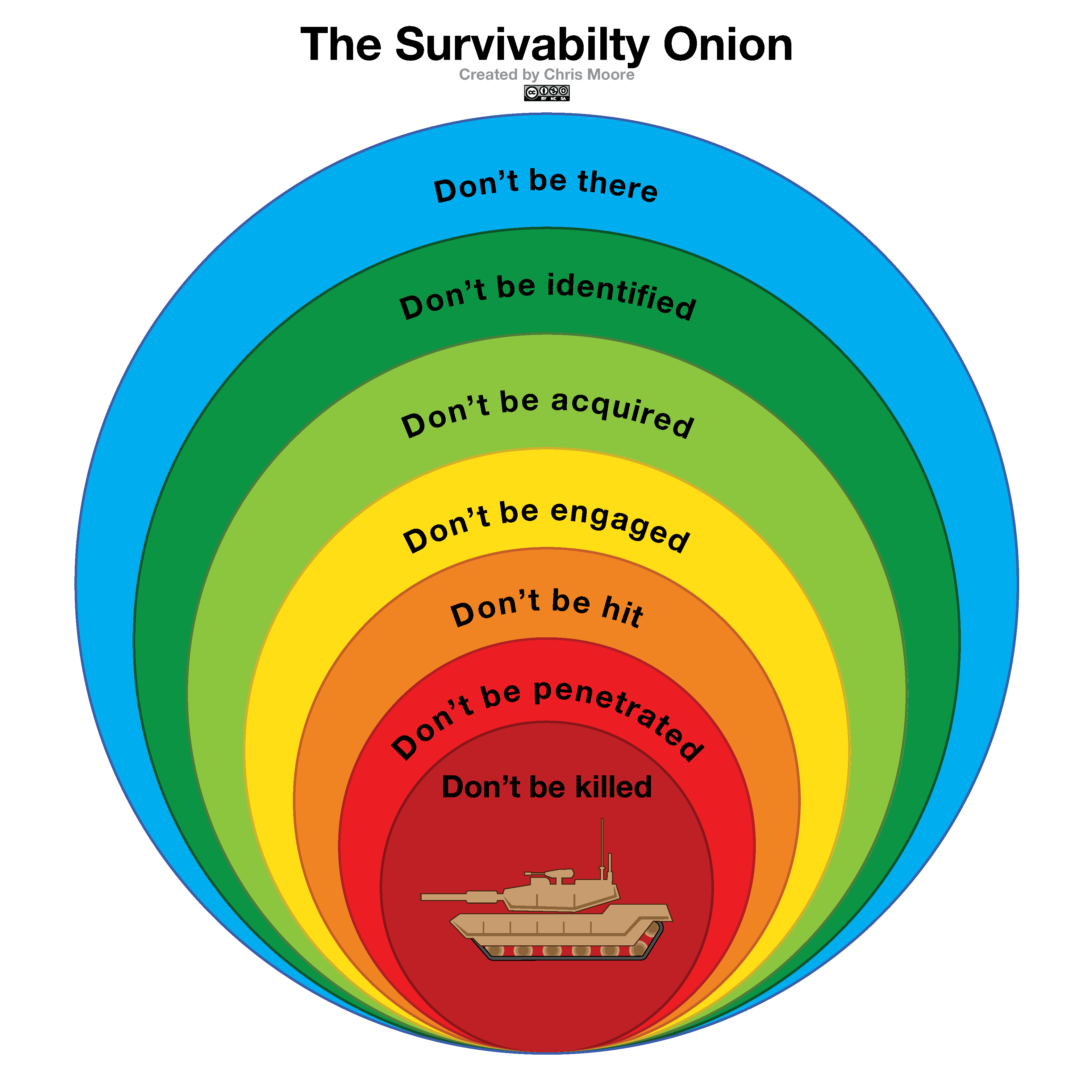
The basic idea here is that just as the largest part of an onion is the outside, the largest part of surviving an attack is not being there. If you can’t not be there don’t be seen. If you can’t not be seen don’t let them aim at you, etc. To make a threat model for our community I’ll use this as an extensive metaphor. I hope nobody reading is allergic to onions.
- Don’t be there
It is true to say that the biggest part of surviving physical violence is also not being there, but here we have to distinguish between disappearing and not being attacked. Not being there might mean not having to be around cis people, and referring back to who in our community is most at risk it should be obvious that doing as much as we can to support the most materially precarious amongst us can make it so they aren’t “there”. This is why celebrating Mira Bellwether Buy A Trans Woman A Pizza Day rather than Trans Day of Visibility is “arming the dolls”.
Not being there doesn’t just mean not being around cis people, to be clear. When we say “liberation, not assimilation”, separatism and assimilation is a false dichotomy. It is not simply one or the other. Maybe it is clearer to say that separation and liberation are not the same. It is a discourse which often also exposes some privilege in those speaking. For a full service transfem sex worker, no contact with cis people, especially the cis people most likely to harm her, is only possible if the community can fix her rent and bills. If a cis person wants to know how they can help, I think sometimes I should say “pick a tranny and pay her a living wage simply for existing”. I think we have to acknowledge that some trannies have 6-figure tech jobs, and that some trans-separatist spaces are almost entirely white.
Spaces for the most oppressed and most criminalised to disappear into is necessary, but we can’t mistake it for the whole answer. Making your community a space that isn’t “there” by providing alternatives is fantastic, but it’s a lot of work and it creates an incredibly intense social membrane. If your community provides everything needed to keep the dolls safe, will interpersonal conflict become a death sentence? Will someone refusing to be pushed out tear your community apart?
The fascists want us to not be anywhere in society, and they’re trying to make the whole world into a “there” we can’t be. Therefore the steps we have to take to “not be there” are steps to make the spaces we exist in not “there”. This means talking to the management of places that you go and insisting upon their commitment to take your side or the side of any trans person if a bigot tries to exclude you or even call the police on you.
If we are talking in practical terms about steps our communities can take, this means working to reduce the precarity of our most vulnerable community members, be it through organising to feed and house them or just sending them cash. We are not in fact, “passing around the same £10”, some of us are doing sex work to survive and some of us have 6 figure salaries.
- Be Seen (As A Person)
Be seen as a person. This one really is the struggle isn’t it? If you are cis and reading this, please read as “see trans women as human beings”. This is all about refusing abstraction. When bigots want to turn the people in a space against us, they reduce us to caricatures, hypotheticals, “what if”s, and to fight that we need the people they are talking to to see us as human beings who don’t deserve to be forced out of public life.
If we can’t not be there, the next best thing we can do to guarantee safety is to be seen as a human being, or at least be seen. To return to my above points about separatism, liberation and assimilation, we can take steps to get cis people around us in our local area and in the spaces we inhabit to see us as human beings. In spaces where you can’t guarantee protection from the people running the space, making friends, saying hi or introducing yourself to the people there will create more safety, more people to turn to if you are under threat and also more people to hopefully put between you and someone who wants to attack you.
In practical terms this is about outreach to cis people around us, getting them up to speed on the attacks on trans existence and if enough people in the space see you as a person, maybe acting collectively to push back to step one and getting the management of the space to commit taking the side of trans people. To say it explicitly: This is easier for white trans women, so we have to do it not just for ourselves but for everyone.
- Deescalate
If we can’t be in spaces where we make friends with all or most of the cis people, we can at least find safety in numbers by going together. If we can’t be seen as people, we have to be with friends, and we need to have each other’s backs.
We (trans people and cis people committed to our safety) should become well versed in bystander intervention training. In bystander intervention we are taught the “four Ds”: Delegate, Direct, Distract and Delay. The idea is that to deescalate a hostile situation, a bystander needs to either delegate to a figure of authority in the vicinity, confront the hostile party directly, distract by engaging the person being targeted in a different way, or delay, meaning helping after the fact.
In this case delegating is only possible if figures of authority are on our side, which goes back to part 1, but we can still be ready to directly confront people who are trying to target trans people, or provide an out by getting between them and the person they are targeting, talking to the trans person and helping them to, you got it, not be there.
On top of this, we should talk seriously about self defense. Getting training in physical self defense doesn’t just mean being confident that you can win a fight, but confident that you can get away from someone who means to harm you. Recognising this need, we can turn this into a practical community step by organising classes and training in both intervention and self defense.
- Do not be arrested
I’m trying to say this as plainly as I can.
Don’t let them take a single one of us.
The law is not the arbiter of morality. Slavery and the Holocaust were legal. This isn’t Extinction Rebellion, we aren’t proving any points or winning any public favour by being civil. They want to send women to men’s prisons to face levels of violence that cannot be prepared for or reasonably understood by people not experiencing them.
The law is not equal. Arrest for a cis person means a fundamentally different thing than arrest for a trans woman, and we need to reckon with that reality in order to be able to act. In order for trans women to be able to live and moreover to be able to fight for our liberation, our community needs to organise training so that when we have the numbers to prevent an arrest, we stop it.
Arm the dolls here means the ability to protest, the ability to engage in direct action, and the ability to piss are all dependent on a proportionate response to the danger trans women face if incarcerated. The proportionate response to that danger is to stop trans women being arrested.
- Do not die
Trans women in prison need our support.
In another of her essays Towards A Women’s Mutiny, Harpy writes:
“Trans women in prison face a miserable life of isolation and sexual assault by both the COs and fellow prisoners. We are most often put in men's prisons and left to die. If our movement is going to get established and sustain itself we need to find our imprisoned sisters and give them lifelines. Letters, visits, and places to go when they're released. The fascist movement has sustained itself through prisoner support for decades, there's no reason we can't apply that same principle.
Nobody is going to fight for a cause that doesn't support its prisoners. Our captured sisters can never be abandoned if we're going to be worth anything.”
She’s right. No notes.
Crucially, if the idea of trans women being sent to men’s prisons upsets you, or if you feel squeamish about the idea of trying to stop the police from arresting someone, I want to remind you why I’ve used the onion metaphor. The absolute biggest part of this is ensuring that trans women are not at risk of physical violence in the first place. We can do most of the work to protect our sisters by finding them safe places to live, ways to not need money, communities that will not turn their backs on them. But when those steps aren’t enough, and they won’t always be, we have to be ready for a more radical approach to preventing violence.
Arm the dolls.