Pluribus: On the ethics of picking an apple

I’ve written my thoughts on the new Vince Gilligan show Pluribus as a response to a tumblr ask that I got just after finishing the show, and have decided to share it here. Enjoy :)
As a note, I got the ask and wrote the initial part straight after finishing the show and then wrote most of this essay today after digesting the audience responses and discovering that my take on the show was not the universal understanding. Out of respect for everyone’s individual autonomy I have decided to not try and convince people to join the hive mind of my take but instead appreciate what is valuable in different perspectives.

Anonymous asks:
So ummm thoughts on Pluribus?
Sophie From Mars responds:
It’s really good!
I haven’t really seen other peoples takes but if nobody else thinks this is what the show is about I’d be completely baffled. It’s about world communism, right? It kind of only works if it’s about someone being unable to adjust to a like total woke communist revolution
Like Carol is the only white person not assimilated and one of the only two people who have a problem with Pluribus (to be clear I also call the hivemind Pluribus and also assume this is what everyone is doing) and the other one is a survivalist prepper guy. She has like an abusive relationship to the entire world, she insists on them stocking the grocery store because she has Yankee brain. White woman’s feelings, 11 billion dead. Etc etc
I think it built up that story really well and while I think she’s absolutely abjectly wrong I also think esp with the cliffhanger that they’ve made room to appreciate the tension of utopia - someone will always be unhappy
Then after answering this question I saw that the audience response was very divided. I chatted to some people about how they had understood the show, trawled around social media a bit digesting takes like “the hivemind is doing White Man’s Burden” and then I wrote this:
Okay so I’ve now had a look at more people’s responses to the show, and I see that there’s actually a lot of quite vicious hostility towards the take I’ve expressed above. Like, a lot of people are being legit quite nasty about this TV show, which is maybe to the writers’ credit, like they’ve created a show that speaks to some stuff people find quite powerful, they’ve made a character people resonate with a lot.
I want to express the above take with a bit more nuance because I think taking the show as only allegorical flattens it, as with many pieces of art. Like it is in actual fact a character drama, and the thing it is literally about is a hivemind entity taking over Earth except for a few remaining individuals.
If we look at the showrunners’ intentions, they talk about the story as that: a character drama with a global hivemind. Asked about whether we can conclude from the finale that Pluribus (the entity) has been manipulative the whole time, Gilligan and Tatlock said this:
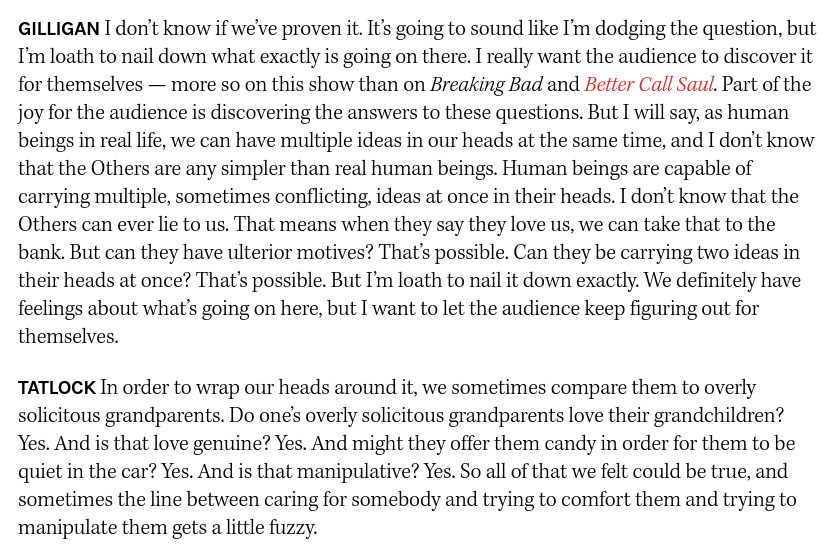
and more broadly they has this to say about the finale and "manipulation":
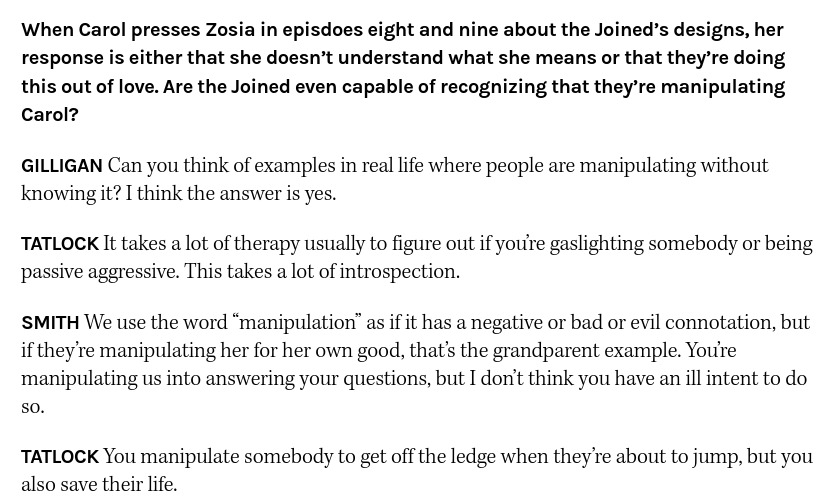
It would be fair to say that the show is being written by people who have many conflicting views about the morality of the literal hivemind situation in the show. We will not know for at least two years until we get more of the show where the story is going and how explicitly or not we will be expected to side with Carol or with Pluribus. Based on the above, it seems quite likely we will continue to be given an ambivalent moral thesis.
But authorial intent only gets us so far, right? What matters to the people watching the show is important because it makes us feel things. What I think can be again marked as a huge success of the show so far is that people are getting mad as fuck at each other, not because some people don’t like the show but because we all like it but seem to be watching different shows.
In the audience response, there have been broadly two camps, which I will characterise as “pro-pluribus” and “anti-pluribus”. I think it worth considering what both readings can mean and can bring to us.
Pro-pluribus
I’m starting with my own take which I will explain better because it is how I experienced the show. I think when I’ve seen people talking about the show with the underlying understanding that Pluribus the entity is evil, I don’t think I’d enjoy that show very much, and if that’s where it goes in future seasons, I’ll probably find that less compelling, but I will also do my best to explain what I think people are describing in that reading of the show.
A “pro-pluribus” take on the show isn’t simply assuming that Pluribus is perfect or morally right, but that it is a depiction of Utopia. For a lot of people, a utopia is a completely static world where no story can be told because everything is already perfect, making the “utopias” that exist in our stories necessarily imperfect because otherwise they would narrative poison. People love telling stories about “What if there was a Utopia, BUT...” and I understand the show to be starting from that premise.
More specifically, there is a history of hivemind stories that fit in the western tradition of anti-communist anti-collectivist media and appeal to the very false notion in the west of what individualism and individual self-expression mean, and to me this show seems to be subverting that history of hive mind stories by having the hive mind obviously be a utopia and interrogating the motives of the people who want to refuse merging.
The people who have remained outside Pluribus mostly seem to be content living in a facsimile of their previous life interacting with Pluribus who is using the individual memories and cognition of their friends and family to simulate the environment they are used to. This makes sense, a lot of people are creatures of habit and we don’t really know much about the other individuals so their lives may not be entirely this. Of these characters, we get a developed sense of Carol, Manousos, Diabaté, Kusimayu and Laxmi, but the show is primarily about Carol and her relationship to Pluribus. Kusimayu, who lived in a Peruvian village and therefore effectively whose whole world has already been merged into Pluribus voluntarily joins the hivemind. Manousos on the other end of the spectrum is so anti-Pluribus (the entity) that he nearly gets himself killed and he acts in destructive and self destructive ways because of his extreme stance. Laxmi mostly acts as a voice of the other individuals in their interactions with Carol and we don’t know tonnes about her. Diabaté is the show’s resident hedonist: he stays in Elvis’ suite in Las Vegas and spends all his time in a holodeck-like fantasy adventuring and having sex with Pluribus. He doesn’t have good motivations but he does have relatable motivations.
Carol the show’s protagonist is the only white individual as far as we know, as well as the only American. She is a bestselling author and a pronounced misanthrope. She begins the show quite alienated from other people and this gets significantly more intense when her partner dies during the hivemind takeover. She, like Manousos, acts in destructive and self-destructive ways, and like Diabaté she also uses the hivemind to summon treats for her, although her demands are mostly much less extravagant than his. She asks Pluribus to turn the lights on in Albuquerque because it unsettles her having them turned off, and she asks for her local supermarket to be stocked so that she can select things for her groceries. These motivations are not unlike what we know of the other individuals but the show in the “pro-pluribus” reading highlights for us how intensely wasteful and self-centered the lifestyles of people in the imperial core are and how allergic we are as white westerners to changes that could benefit the collective wellbeing.
I am also not really sure where to put this but Carol drives around in a cop car for most of the show.

I think it is overall a very fair reading to say one thing this show is about is Americans’ cultural antipathy or allergy to the concept of utopia and the necessary changes away from a model that delivers treats to inhabitants of the imperial core at a massive cost to everyone else. This reading is clearly in line with some parts of the show that have obviously been written with a self-consciousness of American writers writing an American character for Americans, and also aligns with some ways that those same writers interrogate the notion of selfhood versus collective integration because they are again, Americans. Part of what makes this reading politically productive is that Carol is understandable and relatable and not an evil person. She is quite representative of many liberal Americans and westerners generally. The systems that she depends upon however, are evil. It cannot be overstated how significant white people’s whiteness is in our effect upon the world around us, and making Carol the only white individual character in a show is a choice that has been made on purpose and carries meaning
Anti-Pluribus
As I understand it, and again this is not my reading but I am trying to be as charitable as possible in my understanding of it, the anti-pluribus reading is one where the societal change that Pluribus represents is evil. The hivemind is evil and its desire to join people is evil. Carol, a lesbian who was subjected to conversion therapy and a homophobic family environment, does not want to be incorporated against her consent into a greater whole and lose her individuality. Also up until the moment of the joining she had been living a lie in her fiction work by making her originally lesbian love interest character a man, and so has an intensely developed sense of antagonism towards the collective humankind even before it all shared one brain cell.
Not that I think the show is even remotely about this, but I could make an analogy between the Anti-Pluribus reading of the show and the widespread use of AI. This is a large scale social change that I am on the outside of, I think is bad, I see has clear negative consequences, and I am unable to communicate effectively with the people inside of it about because they all think it’s really cool! This helps me to understand this reading better because I do feel a sometimes existential sense of distress and threat at the world that silicone valley men and other allied fascists are trying to create.
A big part of the Anti-Pluribus take as I understand it is about the loss of human individuality. When Kusimayu is integrated into Pluribus, the villagers all stop with the ceremony they were performing immediately, pack up some things from the village and immediately leave, thereby instantly ending their culture. Similarly, we don’t know of any gay characters besides Carol, and so as far as we know when she is integrated there will be no more queer people on Earth. There is of course on a cosmic scale nothing inherently better or more worth preserving about being queer or more noble about indigenous culture, and the people who are integrated into Pluribus seem to really be a part of it going forward, but I think this aligns well with the reaction against sweeping social change - even if what came before is “preserved inside” the new social reality, it is also lost in that the version of it as it existed before is gone forever.
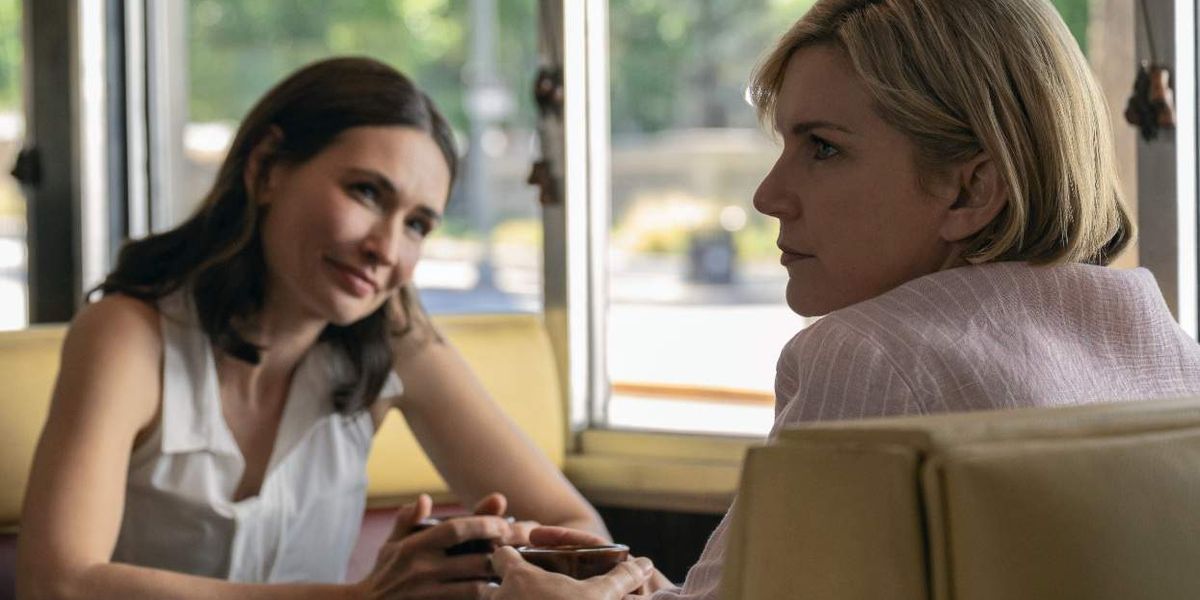
Pluribus doesn’t respect Carol’s consent. This one is a very big textual point towards why we should not like Pluribus and view the joining as bad. This again is a resonant part of the story that for me at least speaks to some of the pain of social change.
Even change that ends inequality can be painful. When distinctions are made between human beings it sucks to be on the oppressed underside of a distinction and for lots of people it is a lifelong struggle to have their side of that distinction recognised as equally human. If we think about queer kids growing up in a future with no homophobia or transphobia or misogyny, we know that’s what we want to happen but it’s also bittersweet because it compounds the horrible meaninglessness of the cruelty that we have suffered in our lives. Similarly, Pluribus ends the concepts of straight, gay, white, indigenous, rich and poor and so on, and for people who have been tortured by these distinctions and found community and solidarity on the edges of them, the sudden absence of them is at least partly painful.
Which one is the show about?
Neither. Both. Yes. Both “sides” here are flattening a nuanced story which inspires us to interrogate really difficult questions about personhood and culture, and I think there is value in both interpretations even if I have my favourite. Here I think it might be better for me to look at some criticisms of the two takes on the show.
The Pro-pluribus take can be criticised on the grounds that the entity does not seem very utopian. We haven’t really seen much of what Pluribus is like on the inside, either experientially or just in the day-to-day, what is Pluribus up to except pandering to these 12 people? Pluribus is also creepy. It uses human bodies to make food and is going to starve anyway.
We only have its word that the people in it are alive, conscious and having a good time. It might be that someone gets un-joined next season and they say that you see creepy little elves all the time when you’re in pluribus and they have scary faces and sometimes the elves touch you and can’t do shit about it because you’re under hive control. Nobody ever thought to ask anyone in pluribus if they were seeing horrible elves all the time.
All in all, the pro-pluribus reading can be critiqued as too willing to see the hivemind as good. I think there is an additional concern here though I haven’t seen much of it that people may be very willing to criticise Carol because she’s a woman, which would make Vince Gilligan 3 for 3 on making super popular shows where a bunch of the fanbase spend the whole time talking about how much they hate women.
The Anti-pluribus take can be critiqued on the grounds that it seems to mostly revolve around Carol being your blorbo. People who see the hive mind as bad mostly cite Carol’s feelings and their feelings about Carol as the basis for explaining this.
The exception to this is discussion of Kusimayu and the vanishing of her culture when she joins Pluribus. From this I have seen people saying that “the show is about colonialism”. I do not think it is very fair to say the show is overall about colonialism, and there just isn’t a lot in reading the show this way imo? And can we have shows about colonialism not by and mainly about white americans then please?
Mostly I think the two sides here have formed in opposition around pluribus good carol bad and pluribus bad carol good, and I think it’s pretty fair to say the writers’ intentions and the text of the show give both a pretty solid basis. I think we are meant to be conflicted in watching the show and that the show is meant to make us look at why people resist the whims of the collective, which reasons are good and resonate with us and which reasons are bad and based only in emotional attachment to “when the world was the right way”. I think that’s what the show is about and I think that’s great. I think it would be still fair to summarise this as about the individual’s allergy to broad social change, despite the sort of optical illusion we seem to be experiencing where either the collective social change or the individual is noble and good and the other bad and regressive.
On the ethics of picking an apple
You’ve read this far. Gotcha.
So I wanna also talk about somewhere I think the show is just a bit strange.
Pluribus can’t feed itself because it respects all life so much and therefore it won’t do any harm, even to plants, because it will not pick an apple. In the season finale, Manousos characterises this as evil. He says to Carol “Isn’t it evil to value a man the same as an ant?”
This is a fine claim. Does it make sense? I think there is an immediate concerning nature to what might be the underpinning logic here. Is it the logic of natural hierarchy? Are there also some people it would be evil to value totally equally? Or is this entirely about a hypothetical where we give Pluribus a gun and demand that it shoots us or else we will stomp on one ant?
From these questions we find ourselves asking questions about Pluribus’ relationship to humanity. It respects all life but seemingly only wants to join with humans. It will keep the pets that stay attached to their former owners but otherwise just let the world be. We can see that human beings are special to Pluribus, which makes sense because it is human and it is of humanity. It was made in a lab by human beings and insofar as it and the thing that sent the signal to Earth can be assumed to be the same thing self-replicating, perhaps it understands humanity creating the genetic sequence as humanity’s consent as a whole to being a part of it, something not dissimilar to warp drive capabilities in Star Trek.
The problem with all of this is that it isn’t actually immoral to pick an apple. It isn’t harmful to the tree and it is actually pretty disputable whether it even “kills” the fruit. Trees make fruit to be eaten by animals so their seeds can be shit out. Even from Pluribus’ perspective it should be pretty trivial to argue that trees as a species, a type of being on the same scale of magnitude as Pluribus, benefit from their fruit being eaten and their seeds being shit out, but in terms of “respecting life” it isn’t actually an unconscionable and reprehensible act to pick a fruit even before we weigh that against the harm that comes to a starving person if they can’t eat it.
The fact that this makes no sense can be seen a few different ways. We could see this bizarre reasoning as due to something we don’t yet know about Pluribus, or perhaps this is straightforwardly a lie and Pluribus has been able to lie all along. Perhaps Pluribus has a notion of life and selfhood that is hard for us to conceive - this seems true on the face of it. We could alternatively look at this as a flaw in the show where the writing has been contrived for plot convenience. But we could see contrivance and this sort of abstraction as a sign of where the writers want the show to be focused. Is it important to the character of the hivemind that is is flawed in this way, unable to act towards basic self preservation by even picking an apple? If so, what do we learn about Pluribus, the entity and the show. There are claims being made there about how human beings acting as a collective consciousness may be flawed or misguided, perhaps. On the other hand is it meant to be unimportant that Pluribus has such flawed reasoning? Is this a broad brush stroke in a part of the composition the artist would rather we don’t look too closely at? Similarly, the hivemind taking over Earth was a pretty glossed over process mostly described after the fact, because this doesn’t seem to be important to what the show is about.
I think for me the ethics of picking an apple is the biggest lingering question of the show right now. Are we supposed to understand something very very integral to what Pluribus the show is about, that Pluribus the entity can’t pick an apple? If so, what?