The Lolita Express and other, more metaphorical vehicles of abuse
On the aspects of power that are broadly going uninterrogated in the Epstein case

We teach our behaviour to ourselves.
A friend of mine said this recently and I really enjoyed it. There’s a central idea there which is expressed in Marx’ definition of ideology Sie wissen dass nicht, aber sie tun es (they don’t know what it is, but they are doing it), but is also captured in the classic “actions speak louder than words” or a phrase my best friend and I love to bring up in discussion of politics and ideology too: “belief follows action”
Perhaps I’ve been missing out on the main body of feminist anaylses on the Epstein case, perhaps they’ve been swept away in all the spectacle and party-politicking as the Democrats and Republicans in turn try to insist that the other is the more pedophilic party, perhaps the general culture of capital-inflated reactionary cultural attitudes have limited the reach of such analyses, but I have felt quite continually frustrated by how our culture seems to be processing the entire situation. It would do a lot of people well to sit with the idea that an enormous number of internationally famous and often rich and powerful people knew Jeffrey Epstein to some degree, and that this is an issue of the ruling class and how our society is structured.
While I haven’t been exhaustively consuming Epstein-related takes and media, and I truly may have just missed all the systemic analyses of the story, I have seen a fair few horrible takes from people whose status as writers in the public eye should suggest they have something worth saying about Epstein, but sadly does not. Graeme Wood, regular contributor to pseudointellectual slop publication The Atlantic, felt deeply compelled by the situation to write a piece deriding the most famous pedophile in the world for not having a very good taste in books.
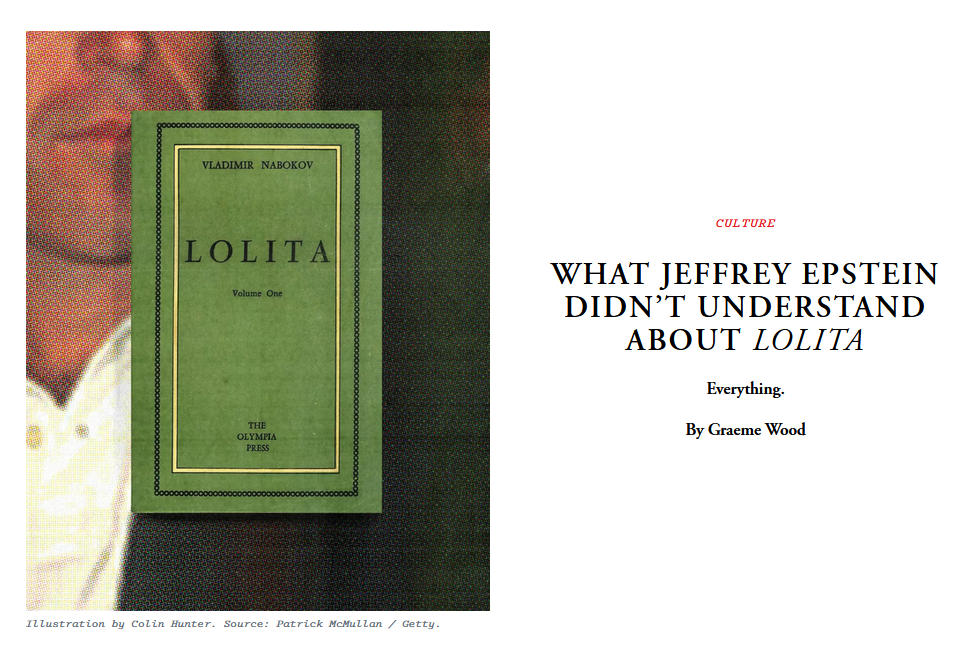
In the piece, Wood explains that in his view, the repulsiveness of Humbert Humbert, the narrator and main character of the book, should have clued Epstein into the fact that abusing children is wrong.
“Humbert is one of the most odious and self-absorbed creations in all of literature. He is a rapist, a murderer, a world-class deflector of blame (“It was she who seduced me”), and a pompous piece of child-molesting Eurotrash. It is a scandal that he can express himself so well—with the linguistic ingenuity, come to think of it, of Vladimir Nabokov. Much of the plot follows this continental sophisticate and Lolita as they drive across America in a “jalopy,” shacking up in motels and passing vulgar roadside attractions. (Epstein, by contrast, was too much of a snob to debase himself with terrestrial travel. He flew private, in a 727 known unofficially as the “Lolita Express.”)
“The end of the novel, however, is even more hateful to someone with Epstein’s predilections. Humbert meets his ex-nymphet again when she’s 17. Lolita has grown distant—which is to say, she has grown up—and has sexually emancipated herself from Humbert, though she still wants his money. Now married and pregnant, Lolita has become unattractive to Humbert, and to some extent Humbert has become unattractive to himself, even remorseful about his crimes against her.”
The immediate flaw with this line of thought to me is that surely Epstein could read such a book and simply feel superior to Humbert, but that’s not really the issue. I find this article a good jumping off point for several things that irk me about the cultural reception of the Epstein scandal. It is entirely typical of the gruel that magazines like The Atlantic pass off as political or cultural commentary, and the gist of the article is that Graeme Wood, unlike Epstein, got the correct message from reading Lolita: that being a pedophile is gross!
The final paragraph of this piece lays Wood’s limpness somewhat bare I think:
“But just as the notion that Epstein read and understood Lolita is implausible, the alternative—that he read the novel and got off on it—is almost too gross to contemplate. To find Lolita sexy would not only mean finding child-rape sexy. It would also mean finding Humbert Humbert sexy. And that is a level of perversion probably beyond even Jeffrey Epstein.”
There is just such a deep lack of insight here into what must have driven Epstein and what continues to drive people like him. The first time I read this ending I could only think that if Graeme can’t believe Epstein understood Lolita but he also finds the idea that Epstein was aroused by the text “too gross to contemplate”, what was the actual point of this article? Those are the two possibilities that there are to interrogate, and Graeme says that there is some insurpassable veil of disgusting “perversion” (an interesting word choice that comes up repeatedly) that beyond which is only abyss. Too gross to contemplate. Too icky to analyse. Too yuck to draw any cogent political meaning from.
To answer my own question, I feel quite strongly that the purpose of Wood’s article is just to demonstrate to his readers that he has read and understood Nabokov (whose name he mocks Michael Wolff for misspelling) and that he, unlike Epstein, is not a pedophile. He is not an “incorrigible pervert”. Graeme is normal.
I think this, right here, undergirds many of the issues I have with how Epstein is discussed, because in exceptionalising Jeffrey Epstein we fail to properly understand the horror of the situation and what must truly be done to address it. Instead of making an earnest effort to understand the systemic incentives that might produce someone like Epstein, he is first labelled as a kind of unique evil unlike most men, and then he is associated with whoever is currently speaking’s political enemy. This cynical and utilitarian approach to the issue of the multi millionaire pedophile island does nothing to meaningfully make the world one less likely to contain a multi millionaire pedophile island.

I think when we are engaging with the fraught exercise of trying to long-distance psychoanalyse a dead pedophile, the exercise that Graeme Wood decided to dip his toes into, looking at “perversion” is a dangerous misstep. Was Epstein doing something unusual, something exclusive and “perverse” in the sense that it was abnormal? Yes, in part. But on multiple fronts he was also acting in a very normal, very expected way.
Epstein reportedly kept a copy of Nabokov’s novel Lolita by his bed, and famously named his private jet after the book too. In these details we can see that there is something to the idea that Epstein knew and enjoyed the idea that he was unusual, abnormal, perverse.
One of Epstein’s first accusers was a trans girl, and I’m not speaking colloquially I mean she was underage. Ava Cordero was 16 when according to her account Epstein forced her into “bizarre and unnatural sex acts”. When she came forward about it, she was publicly mocked and ignored with her being trans, her HIV positive status and her past drug use, the very factors of her precarity that made her easy for someone like Epstein to abuse, being paraded in the media to discredit her. I think if people are trying to talk about what motivated Epstein, Cordero’s experiences are relevant.
I want to be careful here for cisgender readers whose understanding may fall down at this point: men who are attracted to trans women are not necessarily doing something strange or perverse, but many historically have been and today many still are. The “chaser” as he is labelled is (typically) a cisgender man whose view of trans women is dehumanising and fetishistic and who sees an appeal in the societal taboo of trans women. I think there is a reasonable argument to make that Epstein enjoyed the idea he was accessing something exclusive sexually that he felt many would also want but only his wealth and connections afforded.
The discursive puzzle pieces that to me are noticeably absent from this response however are all about the things in our culture that produce someone like Epstein. It seems like the obvious analysis that is required in a situation where the people implicated in the case are very much of one group, the ruling class of the imperial core. Instead, as with article’s like Graeme Wood’s, I feel I am seeing a lot of people rhetorically tutting and shaking their heads in a performance of disgust and bafflement at Epstein’s completely unique monstrosity.
If I were trying to order what I feel are the missing pieces of the discourse here, I might group them into three, perhaps four main topics. Firstly, and this is technically the topic that has been touched on the most, it’s just that very few people have been saying anything productive, we have child liberation - how do we give children the agency and power that they need to be able to escape abusive situations and not face the worst kinds of harm to which children are often subjected? Secondly we have to look at patriarchy more seriously as a force in what happened and what Epstein was able to do - these men were misogynists, they saw women as property to be bought and sold and used and discarded. Thirdly, rather than the axes of oppression that made the victims’ position in the power dynamic so low, we should look at the power that their abusers held, since this was not a scheme put together by random people but rather explicitly by and for the wealthy elite.

This is the same culture that produces figures like Andrew Tate who see women not as people but a game to get good at, because in patriarchal capitalist exchange where a man’s status as a man is a significant figure in his overall power, women are a commodity to be attained, kept and even traded. The patriarchal capitalist wants business relationships to other men but at the elite level supposedly shielded from public view he also wants to engage in para-sexual relationships with other successful men by sharing the women they own. The content that Andrew Tate and his fans create recycling his alpha grindset cobra mind gibberish gives an insight into the cultural fusion between incels, bodybuilders, stock traders and the fascist political project. The men and boys consuming Andrew Tate content are being taught to engage with women in a deeply inhuman, cruel and exploitative way.
I recently read Rebecca Solnit’s very good essay Men Explain Lolita To Me, about how upset many men get when presented with the idea that the book is not about what it is like to be a pedophile but rather about a child being raped. These two paragraphs below have been coming up for me a lot as I see the mainstreaming of incel culture, the capitulation by the liberal political establishmen to people who want to strip women of all human rights, and of course the full extent of those implicated in the Epstein files. In particular the quote Solnit includes from Azar Nafisi -
“You can read Nabokov’s relationship to his character in many ways. Vera Nabokov, the author’s wife, wrote, “I wish, though, somebody would notice the tender description of the child, her pathetic dependence on monstrous HH, and her heartrending courage all along…” And the women who read Nabokov’s novel in repressive Iran, says Azar Nafisi of Reading Lolita in Tehran, identified too: “Lolita belongs to a category of victims who have no defense and are never given a chance to articulate their own story. As such she becomes a double victim—not only her life but also her life story is taken from her. We told ourselves we were in that class to prevent ourselves from falling victim to this second crime.”
“When I wrote the essay that provoked such splenetic responses, I was trying to articulate that there is a canonical body of literature in which women’s stories are taken away from them, in which all we get are men’s stories. And that these are sometimes not only books that don’t describe the world from a woman’s point of view, but inculcate denigration and degradation of women as cool things to do.”
The unpersoning of women and girls is a load-bearing part of the process by which they are turned into property for men. I am reminded of So Mayer’s point in their book A Nazi Word For A Nazi Thing that when the Nazis destroyed records on the existence and lives of trans people, the allied forces refused to report on what was being destroyed, thereby aiding in the destruction with a secondary act of erasure. All marginalised people suffer testimonial injustice because silencing and unpersoning are a necessary part of the process of marginalisation.
Patriarchy is in a sense a protection racket. The threat of scarier, worse men is the basis for men insisting their “protection” onto women, because to be a woman in patriarchy is to be protected, precious and property. This is how we see such bizarre contortions of reality as Sir Keir Starmer’s government legislating misogyny as a hate crime only 4 years after Sarah Everard was abducted, raped, murdered and set alight by Police officer Wayne Couzens, known to his colleagues by the nickname “the rapist”. The observable facts of patriarchy and policing, that police exist to protect patriarchal capitalism, that the police are the perpetrators, would not suggest that police should be called in to protect women but rather that women need to liberate themselves from police and the whole world that they represent. But this is some of the horror of being unpersonned, commodified, patronised even.

I think it also benefits us to consider the fetishisation of youth and particularly young girls in our society in this analysis. This topic sits in one sense in between the issue of child liberation and misogyny, but is quite a hefty topic, which is why I said earlier there were three, maybe four parts to this.
Our society treats youth as possessing a natural sexual appeal, especially for women and girls, because our society is patriarchal and in patriarchy women who are weaker, smaller and generally more dependent upon men fit the patriarchal idea of women-as-property better. It is assumed in patriarchal society that a man with an older woman is under her control, and that a man with a younger woman is a success. Because of the gendered nature of this, it might be fairest to say that while young boys are also uncomfortably sexualised sometimes, it is powerful men who are seen as sexy and it is usually older men who hold the most power. The ultimate iteration of heterosexual romance in patriarchy is the wealthy adult man and the child bride.
I feel that a big part of what we are missing is a discusssion of how men who seek to be powerful men are teaching themselves and each other that this is the kind of thing that powerful men in private will want to do.
Famous and wealthy musicians and comedians (often older men) meet and sleep with fans (often younger women) at their shows. This was understood for a long time by a lot of people as a “perk of the job”, despite the overwhelming psychological effect that meeting someone in a setting so oriented around and intensifying of their celebrity, their sense of specialness can have on someone who is a fan of their art. Since #MeToo and the high-profile exposures of many men in the entertainment industry, there has been a general understanding that these kinds of people need to be more careful, but as a general pattern of behaviour this has far from stopped.
There are a set of behaviours based on predatory social dynamics that are so normalised in our culture that were it not for specific crimes, a lot of people would be (and in fact are) saying that there was nothing wrong happening on Epstein’s island, Little Saint James.
This all leaves me thinking again about Humbert Humbert’s “jalopy”, highlighted by Graeme Wood as a symbol of his classlessness and the ways in which he should have been repulsive to Epstein. Perhaps I haven’t moved forward much from my original thought that Epstein would have simply felt superior to Humbert. “But Epstein had a private plane!” I thought, and to his credit, Wood also pointed out in the piece. Trying to articulate this thought a little more pointedly, if the framing is about male status and power, which we should understand discussions of pedophilia, abuse, and misogyny to be, then the relative low status of Humbert would only be a benchmark to exceed for Epstein.
Russell Brand sent a driver, apparently paid by the BBC in a car belonging to the corporation, to pick up a teenager he was abusing from school. This detail stuck out to me as horrid in the woman’s account of Brand, starting from when she was 16, because I thought you would surely know or at least suspect that you were doing something vile, if you were that driver, but I suppose this too is wrapped up the power and implicit threat of a powerful man’s status.
Humbert Humbert’s jalopy, Russell Brand’s BBC car, Epstein’s private plane the Lolita Express, for that matter Little Saint James are all of a set. So are the disproportionate wealth and power of men in the world, the unpersoning of women and children, the patriarchal nuclear family. Some of these things are highly specific to people and stories we have been culturally reacting to, but some of them are everyday aspects of most people’s lives that we must challenge if we want them to change at all. We should respond to learning about a scheme like Epstein’s with an analysis of what elements lead to it and which of them are present in the rest of society, rather than treating him as unique.
We teach our behaviour to ourselves, and when we insist upon a systemic understanding of horrible things in our society we start to learn how to act against the forces that create them. When we see the horrors as unique and completely other we lose a lot of people’s voices and stories