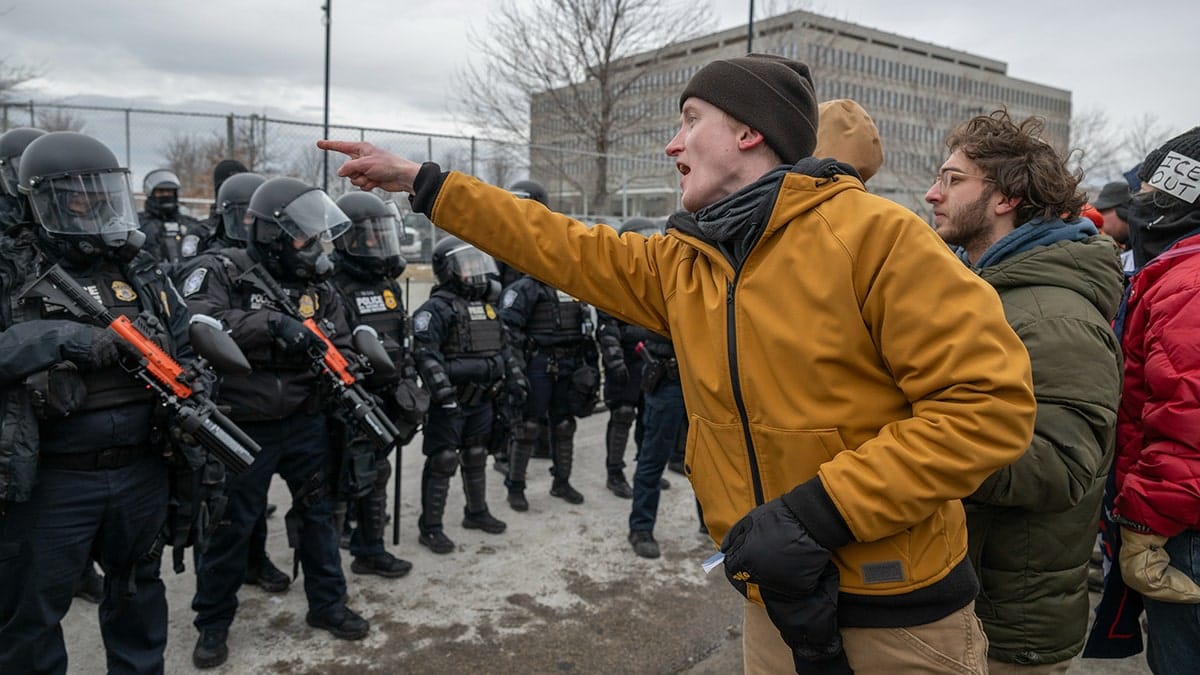
Thoughts on the anti-ICE resistance going on in Minneapolis right now? I find it very inspiring that so many people are openly defying ICE and the police state.
Response to a Tumblr ask
This one is gonna be a long and link heavy answer I think
this week's VOD here: Liberal Slop! ICE in Minneapolis, Obama in the DMs, America in the Cool Zone
On the liberal slop stream this week I looked at a few different takes from the big liberal publications about Minnesota, particularly with a focus on the way that the ruling class and commentariat are responding to it with an adjustment towards a more palatable version of the same structurally fascist changes that we’ve already seen. They’ve sent in Tom Homan, he’s got boring supply teacher energy as opposed to Greg Bovino’s 4chan nazism LARP, and the Economist has written about how Susan Collins could put 🎉checks and balances🎉 in place so that ICE can be a responsible part of American society! It is a real and troubling possibility that the American ruling class have a distinct class interest in that the methods and practices of the Trump administration are made normal and polite. If you want more of me discussing that please check out the VOD above.
As for the resistance itself, I have a lot of thoughts, most of them positive. The main way for a community to respond to the kind of threat that ICE poses, especially past the point that they were grabbing people out of their cars, is for the community to cohere as strongly as possible and avoid leaving people alone and exposed. Margaret Killjoy has done some excellent reporting on the situation from the ground for It Could Happen Here and also wrote this account of the incredible unity of the Minnesotans on her substack
I was especially struck by this part, and as an anarchist heartened to hear it:
“I spent yesterday talking to organizers, but the first thing a friend told me was that, unlike most social movements, there’s not “the guy” to talk to. There just isn’t a central leader, nor some central cadre. There is no vanguard leading the resistance.
The resistance to ICE in Minneapolis is strong, generalized, and sustained. It’s also entirely decentralized and leaderless (or “leaderful” if you’d like). There are roles. There is organizing—there’s so much organizing. There are so many organizers, from so many communities and identities.
This, of course, makes my heart happy.”
Places like the ZAD or like Atlanta forest defense (the Stop Cop City campaign) have shown us that acephalous organising can work and work quite well in the modern context. Perhaps it’s fairer to call these polycephalous structures rather than acephalous, because organic leaders always emerge, it’s just that there are so many of them and such a widespread shared vision exists among the people.
This other piece from Killjoy talks a bit more about specifics of the style of organising and what it is setting out to achieve. It describes spaces and venues occupied and repurposed for community welfare and large scale autonomous networks.
Out of a combination of the Minnesota winter cold and the approach by ICE of just hunting people of colour in the streets (ICE are using a legal stop known as the “Kavanaugh stop” after Brett Kavanaugh where they simply claim a legal right to ask people based on ethnicity to prove their citizenship on the spot), it isn’t safe or easy for the most at-risk population in Minnesota - immigrants and people of colour - to be outside or in public spaces.
“In response to this, many vulnerable people have essentially gone into lockdown. There are families that can’t leave their houses. Other people—friends, families, and neighbors—are looking out for them. The networks that are looking out for them are far and away the largest, most organized, and most successful networks like these I’ve ever seen, and they’re entirely decentralized.”
The notion of a large mutual aid network seeking to protect people who have to hide in their homes is interesting here. It marks out an obvious difference from the most immediately comparable American uprising, which is the George Floyd uprisings in 2020. During the George Floyd riots, protesters and organisers in Seattle claimed the CHOP/CHAZ autonomous zone. Often when there are large scale urban protests break out after a sustained period of political tension and repression, people occupy public spaces and repurpose them for the movement, a physical manifestation of Henri Lefebvre’s idea of the Right to the City. Most famously with the Paris Commune, most notably in the American context in the Occupy protests, and most notably recently with CHOP/CHAZ.
This kind of organising in Minnesota is a more developed structure as an organic social and community structure that is meeting people’s needs as well as both occupying spaces and defending against the state. That’s a sign of real development towards an internally sustainable social organism, although I imagine to many it will appear only reactive and defensive and therefore limited and temporary.
One thing I was interested in discussing on the stream was the cultural frustration at the lack of a strong organised left wing in America. With people outraged over the killings of Renee Good and Alex Pretti, the Trump regime has had to reorganise and regroup, to replan ICE’s approach to the city. That is a time when we have a felt sense we should push forward, but the lack of an established organised left will frustrate that. Everyone wants to push and they can’t. The frustration matters because that is what will drive the creation of a strong organised left wing in America, but it will still feel frustrating.
The general strike is another big sign of development in the organised response to the state, for many reasons both tactical and historical for America. For me thought the really striking (ha!) thing about it is that it can work to perfectly counter attempts to make Minnesotans adapt to the Trump regime’s fascism. The acephlous community organising works in tandem with a general strike, especially where those strong mutual aid networks exist. These together are like the two components of a revolutionary power reactor, because if the strikers can feed and take care of each other they can keep the strike going indefinitely, and the longer the strike can go on the more power the community has to exercise against the ruling class. This is a core idea of long term projects like the ZAD - they support the movement, and the movement supports the liberation of more people and places from capitalism and on and on. Free people free people.
Where it goes next is the biggest lingering question, and for the time being the US government is probably going to keep dictating the progression of the struggle because they are the larger party in the conflict. Therefore the proactive steps for the antifascists are about building up their community cohesion and organised structures rather than their defenses. Not knowing what the feds’ next moves will be, they should try to adapt to become a sort of community that can support an indefinite strike, and push for the choice to strike to become a matter of resisting not just the “unthinkable” new waves of blatant fascism but a matter of resisting “business as usual” as well.